A professional website can make a major difference for an electrical contractor, electrician, energy company, or electrical service provider competing for customers online. A well-designed Electricity Website Design does more than display contact information—it helps businesses explain their services, establish credibility, showcase expertise, and make it easier for potential customers to request a quote.
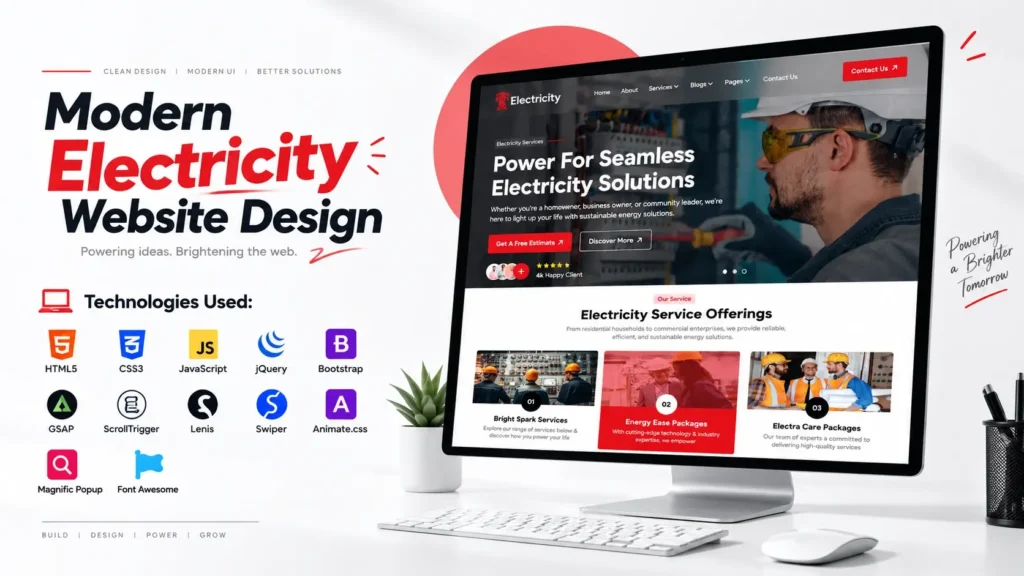
This modern electricity website project is designed around those needs. It combines a professional business layout with responsive design, service sections, customer testimonials, team information, FAQs, pricing elements, contact sections, animations, and modern interactive components.
The project is built using HTML5, CSS3, JavaScript, Bootstrap, jQuery, GSAP, ScrollTrigger, Lenis, Swiper, Animate.css, Magnific Popup, Font Awesome, and other frontend libraries. The result is a visually engaging interface that can be adapted for electrical contractors, power-service companies, energy businesses, electricians, and related service providers.
For a U.S. business, having a mobile-friendly website is particularly important. According to StatCounter, mobile devices account for a substantial share of web traffic in the United States, making responsive layouts an important consideration when building a business website.
Why Electricity Website Design Matters for Electrical Businesses
Electrical services are often local and trust-driven. When someone searches for an electrician or electrical contractor, the website may be one of the first places they visit before making contact.
A strong electrical website should answer several questions quickly:
- What services does the company provide?
- Does the company serve my location?
- Why should I trust this business?
- How can I contact the company?
- Can I request a quote?
- Does the company appear professional and established?
- Can I use the website easily from my phone?
This electricity company website design addresses these user expectations through clearly separated sections and prominent calls to action.
Instead of placing every piece of information on a single page, the layout creates a structured customer journey—from discovering the business to understanding its services and eventually contacting the company.
Overview of This Electricity Website Project
The homepage follows a modern business website structure suitable for an electrical services company.
The main sections include:
| Section | Purpose |
|---|---|
| Hero Section | Introduces the electricity service business |
| About Section | Builds company credibility |
| Services | Presents core electrical services |
| How It Works | Explains the service process |
| Testimonials | Adds customer trust signals |
| Team | Introduces professionals |
| FAQ | Answers common customer questions |
| Contact | Makes inquiries easier |
| Pricing | Presents service packages |
| Blog | Supports content marketing |
| CTA | Encourages visitors to take action |
This structure can be particularly useful for businesses that want a website capable of supporting both local SEO and lead generation.
Modern Hero Section for an Electricity Company
The hero section is one of the first elements visitors see, so it needs to communicate the business purpose immediately.
The project uses the headline:
“Power for Seamless Electricity Solutions”
along with electricity-focused branding and a call-to-action approach.
For an electrical contractor website, the hero section can be customized with information such as:
- Residential electrical services
- Commercial electrical services
- Emergency electrician services
- Electrical installation
- Electrical repairs
- Generator services
- Lighting solutions
- Energy solutions
A business can also add its service area, phone number, operating hours, or quote request button.
Why the Hero Section Matters
Visitors should not have to search through several sections to understand what the company does.
A good hero section should communicate three things quickly:
Service + Value + Action
For example:
Professional electrical services for homes and businesses across your service area.
This makes the purpose of the website immediately understandable.
Electricity Services Website Design
The services section is one of the most important components of an electrical services website.
The project includes a dedicated service area that can be adapted to different electrical businesses.
Possible service categories include:
Residential Electrical Services
This section can promote electrical work for homeowners, including installations, repairs, lighting, wiring, inspections, and upgrades.
Commercial Electrical Services
Commercial contractors can use the section to explain services for offices, retail locations, warehouses, restaurants, and other commercial properties.
Electrical Repairs
A dedicated repair service helps visitors quickly identify whether the company handles their particular electrical issue.
Electrical Installation
Businesses can use this area to promote installation services for lighting, electrical systems, equipment, and other solutions.
Emergency Electrical Services
If a company provides emergency assistance, the website can prominently highlight emergency contact information and availability.
The important point is to keep each service description clear and focused on the customer’s problem rather than filling the page with technical terminology.
Responsive Electrician Website Design
A modern electrician website design should work smoothly across desktops, tablets, and smartphones.
The project includes responsive styling through Bootstrap and custom CSS. The navigation and content structure are designed to adapt to different screen sizes.
Responsive design is especially important for local electrical businesses because customers may search for an electrician while dealing with an immediate problem.
A mobile visitor should be able to:
- Read the main service information
- Open the navigation menu
- Call the business
- Find the service area
- Request a quote
- Read important information
- Navigate between sections
without excessive zooming or horizontal scrolling.
Mobile UX Is More Than Screen Size
One detail that is often overlooked is that responsive design is not simply about shrinking a desktop layout.
Mobile users have different interaction patterns.
Buttons should be easy to tap, phone numbers should be accessible, content should be scannable, and important information should appear without unnecessary interaction.
This is particularly valuable for service businesses where a visitor may be looking for a phone number or emergency assistance.
About Section for Building Trust
The About section gives an electrical company an opportunity to explain who they are and what makes their service different.
The project includes the heading:
“Charged with Purpose to Shaping Future of Energy”
This section can be customized with genuine business information such as:
- Years of experience
- Service locations
- Certifications
- Areas of expertise
- Types of customers served
- Company values
- Safety practices
- Professional qualifications
For an authentic business website, avoid generic claims that cannot be supported. Adding real company information improves credibility and gives visitors a better reason to trust the business.
How It Works Section
The project also includes a dedicated How It Works section.
This is a useful feature for service businesses because customers may not know what happens after they submit an inquiry.
An electrical company could structure the process around:
- Contact the Team
- Discuss Your Electrical Needs
- Schedule an Appointment
- Receive the Service
- Follow-Up and Support
A clearly explained process reduces uncertainty and can make the website easier to use.
Customer Testimonials and Social Proof
The testimonial section is designed to provide space for customer feedback.
For electrical contractors, genuine reviews can be particularly valuable because electrical work involves trust, safety, and professional expertise.
However, testimonials should represent real customer experiences.
Businesses should avoid publishing fabricated reviews simply to make the website look more credible.
A stronger testimonial can include specific details about the customer’s experience, such as:
- Type of service
- Responsiveness
- Professionalism
- Communication
- Quality of work
- Overall experience
Where appropriate, businesses can also connect their website reputation strategy with legitimate reviews from relevant platforms.
Team Section for Electrical Professionals
The team section gives businesses an opportunity to introduce the people behind their services.
Instead of using generic stock identities, a real electrical company can showcase:
- Owner or founder
- Licensed electricians
- Project managers
- Service technicians
- Customer support staff
Including professional photos, names, roles, and relevant qualifications can make a local service business feel more approachable.
FAQ Section for Electrical Services
The FAQ section provides useful information while also supporting search intent.
Common questions can include:
What electrical services do you provide?
The answer should list the actual services offered by the company, such as repairs, installations, inspections, lighting, wiring, or commercial electrical work.
Do you provide residential and commercial electrical services?
Explain which customer types the company serves and whether services differ between residential and commercial projects.
How can I request an electrical service quote?
Provide a simple explanation of the quote process and direct visitors toward the appropriate contact or inquiry form.
Do you offer emergency electrical services?
If emergency services are available, clearly explain availability and the appropriate contact method.
What areas do you serve?
List the actual cities, counties, or service areas covered by the business rather than making broad location claims.
These questions can also be incorporated into FAQ structured data when they accurately reflect visible content on the page.
Technologies Used in This Electricity Website Design
The source-code project uses a combination of frontend technologies and libraries to create its interface and interactions.
HTML5
HTML5 provides the semantic structure of the website, including navigation, content sections, headings, forms, buttons, and other page elements.
CSS3
Custom CSS controls the visual presentation, spacing, typography, responsive behavior, cards, buttons, sections, and animations.
Bootstrap
Bootstrap provides a responsive foundation and helps create layouts that adapt to different screen sizes.
JavaScript and jQuery
JavaScript handles interactive functionality, while jQuery supports several frontend interactions and plugin integrations.
GSAP and ScrollTrigger
GSAP is used for advanced animation capabilities, while ScrollTrigger can connect animations to scrolling behavior.
Lenis
Lenis can be used to create a smoother scrolling experience.
Swiper
Swiper supports modern touch-friendly sliders and carousel-style interfaces.
Animate.css
Animate.css provides reusable CSS animation effects that can be applied to interface elements.
Magnific Popup
Magnific Popup can support modal and popup experiences, including media-related interactions.
Font Awesome
Font Awesome provides scalable icons that can be used throughout the interface.
Together, these technologies provide a strong frontend foundation for a modern electricity website template.
Why This Website Structure Works for Local SEO
A visually attractive website is only one part of a successful online presence.
For a U.S. electrical contractor, the website should also communicate local relevance.
Useful elements include:
- Clearly defined service areas
- Individual service pages
- Consistent business information
- Local business schema where appropriate
- Location-focused content
- Helpful FAQs
- Contact information
- Internal links between related services
- Optimized page titles and descriptions
- Fast-loading images
- Mobile-friendly design
One important insight is that businesses should avoid creating dozens of nearly identical city pages simply by replacing a city name.
A better strategy is to create genuinely useful location pages that include information relevant to customers in that particular area.
SEO Opportunities for This Electricity Website
The template can serve as a starting point for targeting different search intents.
Commercial Keywords
Examples include:
- electricity services
- electrical services company
- electrical contractor
- electrician services
- residential electrician
- commercial electrical services
Local Keywords
Businesses can combine their actual service areas with service terms, such as:
- electrician in Dallas
- electrical contractor in Houston
- residential electrician in Phoenix
- commercial electrician in Chicago
Location keywords should only be used when the business genuinely serves those areas.
Informational Keywords
A blog can target questions such as:
- How often should electrical systems be inspected?
- What are common signs of electrical problems?
- How much does an electrical inspection cost?
- When should you call an emergency electrician?
- What should you know before upgrading an electrical panel?
This creates opportunities to attract users earlier in the buying journey.
Performance and Conversion Considerations
A common mistake in website-template projects is focusing heavily on visual effects while overlooking performance.
Animations can make a website feel modern, but they should support the user experience rather than distract from it.
Before launching the project for a real business, consider:
- Compressing large images
- Using modern image formats where appropriate
- Removing unused libraries
- Minifying production assets
- Loading scripts efficiently
- Testing Core Web Vitals
- Checking mobile performance
- Testing forms
- Verifying all links
- Testing the website on multiple browsers
The source project includes several frontend libraries, so developers should review which dependencies are actually required for the final implementation.
This is one area where customization can make a major difference between a visually impressive demo and a production-ready business website.
Customizing the Electricity Website Template
The project can be adapted for different electrical and energy-related businesses.
Possible customizations include:
Branding
Replace the demo logo, colors, typography, favicon, and visual assets with the company’s actual brand identity.
Services
Modify the service cards and descriptions according to the company’s real offerings.
Contact Information
Replace placeholder phone numbers, email addresses, and locations with verified business information.
Testimonials
Add genuine customer feedback and relevant review information.
Service Areas
Create accurate location-focused content based on the company’s actual coverage.
Calls to Action
CTA buttons can be changed to actions such as:
- Request a Quote
- Schedule Service
- Call an Electrician
- Book an Inspection
- Contact Our Team
Source Code Structure
The project follows a conventional frontend structure that makes it easier for developers to locate major assets.
The primary homepage is contained in:
index.html
The main custom stylesheet is:
assets/css/main.css
The project also includes plugin stylesheets for Bootstrap, AOS, Font Awesome, Magnific Popup, Owl Carousel, Slick Slider, mobile navigation, sidebar functionality, and other components.
JavaScript assets are organized separately, allowing developers to identify scripts and plugin dependencies more easily.
This organization can be helpful for beginners who are learning how HTML, CSS, JavaScript, libraries, and assets work together in a complete website project.
Who Can Use This Electricity Website Design?
This project can be adapted for a range of businesses, including:
- Electrical contractors
- Local electricians
- Residential electrical companies
- Commercial electrical contractors
- Electrical maintenance companies
- Energy service businesses
- Power service providers
- Lighting service companies
- Electrical installation businesses
- Electrical equipment service providers
The design can also serve as inspiration for developers building custom websites for service-based businesses.
What to Check Before Publishing
Before deploying the customized website, run through this checklist:
- Replace all placeholder content
- Add the correct company logo
- Verify phone numbers and email addresses
- Check every navigation link
- Test contact and quote forms
- Add real service areas
- Optimize images
- Test mobile responsiveness
- Check page speed
- Add SEO titles and descriptions
- Implement appropriate schema markup
- Add analytics and Search Console
- Review accessibility
- Test major browsers
- Remove unused demo sections
These steps help transform a template-style project into a more reliable production website.
Final Thoughts
A successful Electricity Website Design should combine professional presentation, clear service information, responsive usability, strong calls to action, and a structure that supports SEO.
This project provides a useful frontend foundation with HTML5, CSS3, JavaScript, Bootstrap, GSAP, ScrollTrigger, Lenis, Swiper, Animate.css, Magnific Popup, Font Awesome, and other supporting libraries.
Its homepage structure—covering electricity services, company information, workflow, testimonials, team members, FAQs, contact details, pricing, and blog content—makes it adaptable to a variety of electrical service businesses.
The most important step after selecting a website project is customization. Replace generic information with genuine business details, optimize the content around actual customer questions, add accurate service areas, improve performance, and make every CTA serve a clear purpose.
For developers, the project also provides a practical example of how multiple frontend technologies can work together to create a modern service-business website.
For electrical businesses, it can serve as a starting point for building a stronger digital presence and creating a clearer path from website visitor to potential customer.
Frequently Asked Questions
What is an Electricity Website Design?
An Electricity Website Design is a website interface created specifically for electrical contractors, electricians, energy businesses, and electricity service providers. It typically includes service information, company details, testimonials, FAQs, contact options, and lead-generation elements.
What technologies are used in this electricity website project?
The project uses HTML5, CSS3, JavaScript, Bootstrap, jQuery, GSAP, ScrollTrigger, Lenis, Swiper, Animate.css, Magnific Popup, Font Awesome, and other frontend plugins.
Is this electricity website responsive?
Yes. The project uses responsive design techniques and Bootstrap-based layouts to support desktop, tablet, and mobile screen sizes.
Can I customize the electrician website design?
Yes. The HTML, CSS, JavaScript, images, branding, service content, contact details, colors, and other frontend elements can be customized according to the project’s requirements.
Can this design be used for an electrical contractor website?
Yes. The structure can be adapted for residential electricians, commercial electrical contractors, electrical service companies, energy businesses, and related service providers.
What should an electrical business include on its website?
An electrical business website should generally include its services, service areas, contact information, company information, customer reviews, FAQs, calls to action, and useful educational content.
How can I optimize an electricity website for Google?
Start with helpful service content, descriptive page titles, relevant headings, accurate local information, internal links, responsive design, optimized images, good page performance, appropriate structured data, and content that answers real customer questions.
Why is responsive design important for an electrician website?
Responsive design allows customers to use the website across smartphones, tablets, and desktops. This is particularly important for local service businesses because customers may search for services from mobile devices.
Can developers use this source code for learning?
Yes. The project structure can be useful for developers learning how HTML, CSS, JavaScript, Bootstrap, animation libraries, plugins, and website assets work together in a modern frontend project.
How can I improve this website before using it for a real business?
Replace placeholder information, verify all links and contact details, optimize images, review third-party libraries, test forms, improve performance, add accurate business information, implement SEO elements, and thoroughly test the website on mobile and desktop devices.
Video Preview of the Electricity Website Design
If you want to demonstrate the visual experience of this project, a short video can show the homepage, navigation, service sections, animations, and responsive design.
For a website-template or source-code showcase, showing the actual interface first and briefly displaying the underlying code can give viewers both visual context and technical insight.
Related Templates You May Like
1 people bought this
Grab it Now for Just 499 ₹999