A well-designed online store has to do more than display products. It needs to create a strong first impression, make product discovery easy, work smoothly across devices, and give visitors enough visual confidence to continue browsing. This is especially important for jewelry and cosmetics brands, where presentation plays a major role in how customers perceive a product.
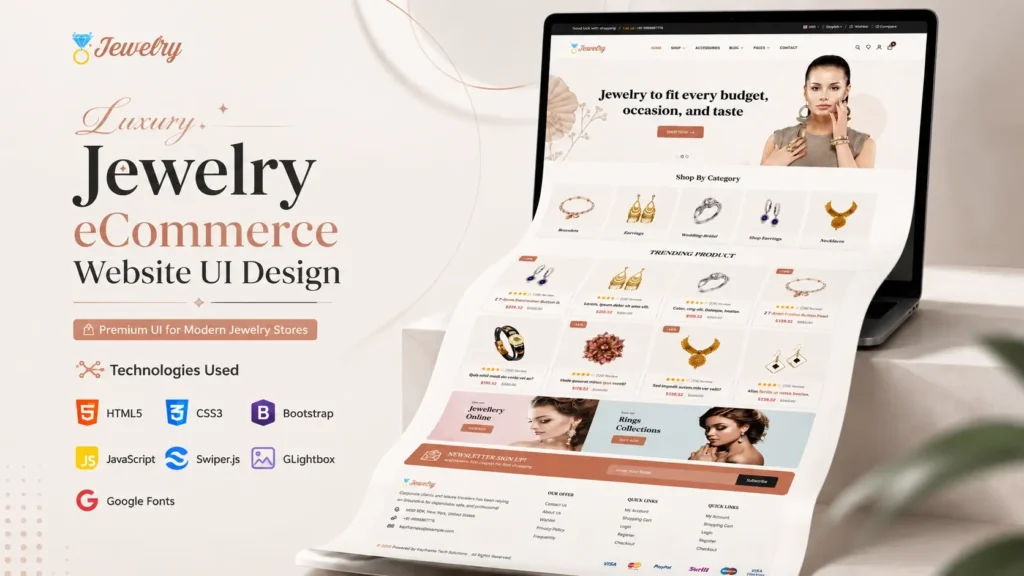
This Jewelry and Cosmetics eCommerce Website Design project combines a luxury-inspired visual style with a practical eCommerce interface. Built with HTML5, CSS3, Bootstrap, JavaScript, Swiper.js, GLightbox, and Google Fonts, the template provides a strong frontend foundation for jewelry stores, beauty brands, cosmetics businesses, fashion retailers, and other visually driven online shops.
The timing is also relevant. eMarketer estimates that ecommerce represented 20.5% of worldwide retail sales in 2025, with global retail ecommerce sales reaching approximately $6.42 trillion.
That growth means businesses need websites that are not only attractive but also responsive, usable, and ready to evolve.
What Is This Jewelry and Cosmetics eCommerce Website Design?
This project is a modern frontend eCommerce website focused on the jewelry, cosmetics, beauty, and fashion industries.
The homepage uses a premium visual approach to showcase products and promotional content without making the interface unnecessarily complicated. Large imagery, product cards, navigation elements, sliders, promotional areas, and content sections work together to create a complete online shopping experience.
The source code is structured around familiar frontend technologies, making it suitable for developers who want to study an eCommerce interface or adapt the design for their own project.
The design can be customized for:
- Jewelry stores
- Cosmetics brands
- Beauty product businesses
- Skincare stores
- Fashion retailers
- Accessories shops
- Boutique businesses
- Luxury product brands
- Online gift stores
- Lifestyle eCommerce websites
The important point is that this is a frontend website project. Product management, authentication, payment processing, order management, inventory, and other backend functionality would need to be connected separately.
Why a Strong eCommerce Website Design Matters
In an online store, customers cannot physically touch a necklace, inspect a cosmetic product, or try an accessory before purchasing. The website therefore becomes part of the product experience.
A cluttered layout can make even attractive products feel less valuable. On the other hand, a clean interface can make product imagery, pricing, offers, and brand messaging easier to understand.
This is particularly important for luxury-oriented industries.
A jewelry website, for example, often benefits from:
- Large and high-quality product imagery
- Generous spacing
- Elegant typography
- Clear product categorization
- Strong calls to action
- Simple navigation
- Responsive layouts
- Visually consistent product cards
The same principles can be applied to cosmetics and beauty stores, although cosmetics websites may also require stronger category navigation and promotional merchandising.
Key Features of the eCommerce Website Template
1. Luxury-Inspired Homepage
The homepage is designed to immediately communicate a premium brand experience.
The hero area provides a large visual space for highlighting collections, products, campaigns, or seasonal promotions. This gives businesses an opportunity to communicate their strongest offer before visitors start exploring individual products.
For a jewelry brand, this could be used to promote a new collection. A cosmetics business could use it for a skincare range, makeup launch, or seasonal campaign.
2. Responsive Navigation
Navigation is one of the most important components of an eCommerce website.
The template includes a structured navigation system that can be adapted for categories such as:
- New Arrivals
- Jewelry
- Rings
- Necklaces
- Earrings
- Cosmetics
- Skincare
- Makeup
- Accessories
- Offers
A responsive navigation experience is especially important because shoppers can arrive from desktops, tablets, and smartphones.
3. Hero Slider
The homepage includes slider functionality powered by Swiper.js.
Sliders can be useful for presenting several important campaigns without consuming the entire homepage with separate large sections.
For example, different slides could highlight:
Slide 1: New Jewelry Collection
Slide 2: Beauty Essentials
Slide 3: Seasonal Collection
Slide 4: Special Promotion
Swiper also gives developers a convenient starting point for adding responsive and interactive carousel behavior.
4. Product Showcase Sections
Product sections are central to any eCommerce UI design.
The template provides product-focused areas where developers can showcase items with imagery, product names, prices, promotional labels, and action controls.
These sections can be customized according to the store’s merchandising strategy.
Instead of showing products randomly, businesses should organize products around user intent.
For example:
| Store Type | Useful Product Sections |
|---|---|
| Jewelry | New Arrivals, Best Sellers, Rings, Necklaces |
| Cosmetics | Trending Products, Skincare, Makeup, Best Sellers |
| Beauty | Featured Brands, Skin Essentials, New Products |
| Fashion | New Collection, Trending, Accessories, Sale |
This simple approach can make a homepage much easier to navigate.
5. Promotional Sections
Promotional banners can help separate different product groups while also communicating important campaigns.
They can be used for:
- Seasonal collections
- New launches
- Brand campaigns
- Gift collections
- Limited-time promotions
- Category highlights
- Special events
However, promotional sections should support the shopping journey rather than overwhelm it. Too many competing banners can make the page feel visually noisy.
6. Product Interaction and Lightbox Support
The project includes GLightbox, which can be used for image and media presentation.
For visually driven stores, this can be particularly useful because customers often want to inspect product images more closely.
Jewelry websites can use larger product images to highlight details such as:
- Stone settings
- Metal finishes
- Product texture
- Close-up craftsmanship
- Packaging
Cosmetics brands can similarly use imagery to show shades, textures, packaging, and product details.
7. Newsletter Section
The homepage also contains a newsletter area.
A newsletter can become an important retention channel for eCommerce brands. Instead of depending entirely on visitors returning organically, businesses can use email to communicate:
- New collections
- Product launches
- Seasonal campaigns
- Editorial content
- Brand updates
- Special promotions
The frontend form itself does not automatically create an email marketing system. A developer needs to connect it to an appropriate backend or email service.
8. Mobile-Friendly Interface
Responsive design is not optional for modern eCommerce websites.
The 2025 Web Almanac found that ecommerce sites represented approximately 19.2% of analyzed mobile sites, illustrating how significant online retail is within the mobile web ecosystem.
The project uses Bootstrap and responsive CSS techniques to adapt the interface to different screen sizes.
Before publishing a customized version, however, developers should test:
- Mobile navigation
- Product card sizing
- Hero image cropping
- Button spacing
- Typography
- Slider behavior
- Forms
- Footer layout
- Touch interactions
Responsive design should be tested on real devices rather than judged only by resizing a desktop browser window.
Technologies Used
HTML5
HTML5 provides the structural foundation of the website.
The markup organizes the page into logical components such as navigation, hero content, product areas, promotional sections, forms, and footer content.
CSS3
Custom CSS controls the visual presentation of the template.
It can be modified to change:
- Colors
- Typography
- Spacing
- Borders
- Buttons
- Product cards
- Responsive behavior
- Section layouts
Bootstrap
Bootstrap provides a responsive grid and reusable interface components.
Developers familiar with Bootstrap can quickly modify the layout without rebuilding the entire responsive system from scratch.
JavaScript
JavaScript powers interactive behavior throughout the frontend.
It can be extended to support dynamic product filtering, cart interactions, form validation, AJAX requests, and other application functionality.
Swiper.js
Swiper.js is used for interactive sliders and carousel-style content.
It is particularly useful for product showcases, hero banners, category carousels, and responsive content sliders.
GLightbox
GLightbox provides a lightweight approach to displaying images and other media in an overlay.
For jewelry and cosmetics websites, this can improve the way detailed product imagery is presented.
Google Fonts
Typography has a significant influence on the visual personality of a luxury eCommerce website.
Google Fonts provides flexible typography options that can be customized according to the brand identity.
Why This Template Works Well for Jewelry and Beauty Brands
There is an important design principle behind this project: visual hierarchy should support product discovery.
Jewelry and cosmetics are highly visual categories. Customers often make initial judgments based on photography, color, typography, packaging, and overall presentation.
That means the website should allow products to remain the visual focus.
A common mistake is adding too many effects simply because an eCommerce website can support them.
Instead, a better approach is to use animation and interaction selectively.
For example:
- Use a slider for important campaigns.
- Use large imagery for hero products.
- Use whitespace to create a premium appearance.
- Use clear buttons for important actions.
- Use consistent product cards throughout the store.
- Keep navigation predictable.
- Avoid unnecessary animation around important product information.
This makes the website feel more polished without sacrificing usability.
How Developers Can Customize the Source Code
One of the biggest advantages of working with a structured HTML/CSS/JavaScript project is that individual components can be modified without redesigning everything.
Step 1: Customize the Brand
Start by replacing the default:
- Logo
- Brand name
- Typography
- Color palette
- Social links
- Contact information
The visual identity should be consistent across every section.
Step 2: Replace Product Content
Update product images, names, descriptions, pricing, categories, and promotional labels.
Use consistent image dimensions wherever possible. Inconsistent product photography can make an otherwise professional storefront look unfinished.
Step 3: Modify Navigation
Create categories that match the actual product catalog.
Do not copy a generic navigation structure if it does not reflect the business.
A smaller jewelry store may only need a handful of categories, while a large cosmetics catalog may require several layers of product classification.
Step 4: Connect Backend Functionality
The frontend is only one part of a complete eCommerce system.
A production website may need:
- Product database
- Shopping cart
- User accounts
- Search
- Product filtering
- Checkout
- Payment gateway
- Order management
- Inventory management
- Shipping integration
- Email notifications
These features require backend development or integration with an eCommerce platform.
Step 5: Optimize Images
High-quality product imagery is essential, but unnecessarily large image files can slow down the website.
Use modern image formats where appropriate, compress images carefully, specify dimensions, and serve appropriately sized images for different devices.
Step 6: Improve SEO
The visual template should be supported by proper technical and on-page SEO.
Important areas include:
- Descriptive page titles
- Unique meta descriptions
- Semantic HTML
- Proper heading hierarchy
- Descriptive image alt text
- Clean URLs
- Internal linking
- Product structured data where applicable
- Fast page performance
- Mobile usability
A beautiful frontend alone does not guarantee search visibility.
SEO Tips for a Jewelry and Cosmetics eCommerce Website
If you plan to turn this frontend into a real store, build SEO into the project from the beginning.
Use Search-Friendly Product Names
Avoid generic product names such as:
“Product 01”
Instead, use descriptive names that communicate what the product actually is.
For example:
“Gold Plated Pearl Drop Earrings”
is more useful than:
“Earring Product 01”
Create Useful Category Pages
Category pages can target broader search intent while individual product pages target specific product searches.
For example:
Jewelry
→ Earrings
→ Necklaces
→ Rings
→ Bracelets
This creates a logical information architecture.
Write Original Product Content
Do not simply copy manufacturer descriptions across hundreds of product pages.
Create useful descriptions that explain:
- Materials
- Dimensions
- Colors
- Usage
- Care instructions
- Product benefits
- Packaging
- Delivery information
For cosmetics, include relevant information such as skin type, ingredients, shade, finish, or usage instructions where applicable.
Optimize Images
Use descriptive filenames and meaningful alt text.
For example:
gold-pearl-drop-earrings.webp
is more informative than:
IMG1234.webp
The alt text should describe the image naturally and should not be stuffed with keywords.
A Detail Many eCommerce Templates Miss: Performance
A visually impressive homepage can become a problem if it loads too many large images, scripts, fonts, and third-party libraries.
This is especially relevant for image-heavy jewelry and cosmetics websites.
Before launching, check:
- Largest Contentful Paint
- Interaction to Next Paint
- Cumulative Layout Shift
- Image sizes
- JavaScript execution
- CSS delivery
- Font loading
- Third-party scripts
The goal is not simply to make a website look impressive. It should feel fast while users browse products.
A useful workflow is to first establish the visual design and then progressively optimize assets and interactions.
Who Should Use This eCommerce Website Project?
This template can be useful for several types of users.
Beginners
Beginners can study the HTML structure, Bootstrap classes, CSS styling, and JavaScript interactions to understand how a modern eCommerce homepage is assembled.
Frontend Developers
Developers can use the project as a starting point for building a more complete eCommerce frontend.
Web Designers
Designers can use the layout as inspiration for creating premium jewelry, cosmetics, beauty, fashion, or lifestyle interfaces.
Agencies
Web development agencies can adapt the design direction for client projects while rebuilding the content and functionality according to the client’s requirements and licensing terms.
Students
Students working on frontend projects can examine how different technologies work together within a practical website interface.
What You Should Check Before Using the Source Code
Before integrating any template into a commercial project, review its license and third-party asset permissions.
You should also check whether external libraries, fonts, images, icons, and other assets have separate usage conditions.
From a technical perspective, inspect:
- HTML structure
- CSS dependencies
- JavaScript libraries
- Image assets
- Font dependencies
- External URLs
- Forms and their actions
- Responsive breakpoints
- Accessibility
- SEO elements
This step can prevent unnecessary problems later.
Final Thoughts
A successful jewelry or cosmetics website needs a balance between luxury, usability, performance, and functionality.
This Jewelry and Cosmetics eCommerce Website Design provides a strong frontend starting point with HTML5, CSS3, Bootstrap, JavaScript, Swiper.js, GLightbox, and Google Fonts.
Its responsive layout, product-focused sections, hero slider, promotional areas, image presentation, and modern visual hierarchy make it suitable for a wide range of beauty and eCommerce projects.
The most important next step is customization. Replace the sample branding and content, optimize the images, connect the required backend functionality, improve technical SEO, and test the complete experience across real devices.
A template should be treated as a foundation—not the finished product. The businesses that get the most value from an eCommerce UI are the ones that adapt it around their customers, products, brand identity, and search intent.
Frequently Asked Questions
What is a Jewelry and Cosmetics eCommerce Website Design?
A Jewelry and Cosmetics eCommerce Website Design is an online store interface created specifically for jewelry, cosmetics, beauty, accessories, and related products. It typically includes product showcases, navigation, promotional sections, responsive layouts, and shopping-focused UI components.
Which technologies are used in this eCommerce website template?
The project uses HTML5, CSS3, Bootstrap, JavaScript, Swiper.js, GLightbox, and Google Fonts for its frontend structure, styling, typography, and interactive elements.
Is this jewelry website template responsive?
Yes. The project uses Bootstrap and responsive CSS techniques to adapt the frontend layout to different screen sizes. Developers should still test their customized version on real smartphones, tablets, and desktop devices.
Can I customize the jewelry and cosmetics website design?
Yes. The HTML, CSS, JavaScript, images, typography, colors, navigation, product sections, and promotional content can be customized according to the requirements of the project.
Can this template be converted into a complete eCommerce website?
Yes. The frontend can serve as a starting point for a complete eCommerce application. Backend functionality such as product databases, authentication, cart management, checkout, payment processing, orders, inventory, and shipping needs to be integrated separately.
Is Bootstrap used in this eCommerce project?
Yes. Bootstrap is included to support responsive layouts and reusable frontend components.
What is Swiper.js used for in the template?
Swiper.js is used for interactive sliders and carousel sections. It can be used for hero banners, product showcases, categories, and other horizontally scrollable content.
Is JavaScript required to customize the template?
Basic HTML and CSS knowledge is enough for simple visual changes. JavaScript knowledge becomes important when modifying interactive features or adding functionality such as filtering, dynamic product behavior, cart interactions, or form validation.
Can this design be used for a cosmetics store?
Yes. The layout can be adapted for cosmetics, skincare, makeup, beauty products, personal care brands, and other visually focused eCommerce businesses.
What should I optimize before launching the website?
Before launch, optimize images, page speed, responsive behavior, accessibility, metadata, heading structure, internal links, URLs, product content, structured data, and mobile usability. Also connect the required backend and test all forms and interactive features.
Conclusion
The combination of premium visual design and practical frontend development makes this Jewelry and Cosmetics eCommerce Website Design a useful starting point for modern online retail projects.
Whether you are learning frontend development, designing a jewelry store, building a cosmetics brand website, or developing an eCommerce project for a client, the source code provides a structured foundation that can be expanded into a complete online shopping experience.
Video Preview
Related Templates You May Like
13 people bought this
Grab it Now for Just 499 ₹999